Tuesday, August 10, 2010

My Will

I have just sent a message to Anglicare, the social arm of the Diocese of Sydney.
This was in response to  a news item this weekend.
"The chief executive of Anglicare, Peter Kell, cites a child's need for both a mother and father among the 11 reasons why same-sex couples should not be given the same rights as heterosexual couples under adoption law."


My message was:
'About 15 years ago I drew up a will giving half my assets (about $xxxxxx) to Anglicare. This has been an increasing worry to me. I am glad to report that 2 weeks ago I drew up a new will giving those assets to Anglican Family Care, Dunedin. 
I have recently moved to the Diocese of Dunedin where Bishop Kelvin Wright, now a friend, often preaches in favour of gay acceptance and a partnered gay man is an assistant priest in the cathedral and regularly preaches and presides. They preach the Gospel of Love rather than the gospel of hate preached in the Sydney Diocese.  While living in Sydney I was a parishioner of St James, King Street, an island of sanity within the diocese, but it sickened me to think that any of my money should be used in the name of the Diocese.'

If you are interested, the remainder of my assets go to my sister but, in the event of her pre-deceasing me, to Medecins Sans Frontieres.  Sadly I am increasingly wary of giving my money to Church welfare agencies unless I can be sure they act without ulterior motives.

Addendum
I should post them this excellent piece by my internet friend Betty (Birdie)

http://www.bilerico.com/2010/08/an_open_letter_to_my_fellow_straight_christians_ab.php

but it would be throwing pearls before swine.

I hope to meet up with Birdie while visiting Chicago.

Thursday, July 29, 2010

Travel Plans Part 3

It is just over a week until I leave Dunedin. I have mixed feelings. Never thought that after only 6 months I would be feeling sad at leaving both the city and my new friends.

I have made some changes to my New England plans and there are some problems with Nova Scotia. I discovered that I could catch a train from Albany to Port Kent in upper New York State and from there travel across the lake by ferry to Burlington. I was able to cancel the hotel reservation in Springfield. After the 3 days in Burlington I will catch the train to New Haven and then the next morning to Boston. I hope to visit both Salem and Concord.


After flying from Boston to Halifax I plan to catch the bus to Baddeck the same day,  do a tour of the Cabot trail the next day then back to Halifax.  However the Tour operator will not take a booking until they have at least 2 people for the trip so I need to ring closer to the date.
I am wondering if it will be better to just spend 4 nights in Halifax.

I am booked on the overnight train from Halifax to Montreal. After 2 nights there I have a train ticket to Quebec for 3 nights then back through Montreal to Ottawa for 4 nights.

From Ottawa to Toronto for 2 nights but I have booked a full day return by train to Niagara Falls so I will not see much of Toronto.

Then I fly to San Francisco for 2 nights before tackling the long overnight journey back to Auckland, of course losing a whole day in the process.

I will arrive Auckland on October 31 at 5.45am and catch the 7.15am plane arriving Dunedin at 9.30am. Sorry I will not be at the 10 am Eucharist but will have to wait until the afternoon to collect my car as it is being stored in the garage of one of the church wardens.

I am keen to see friends back in Sydney and excited about the Norway cruise, the Proms in London and the Passion Play. It will be great to meet people from online as I travel through the USA but I am feeling I may be a bit deflated  by the time I reach Canada and just want to get home.
It is just hitting me that I will be away for 12 weeks which is longer than any time away since way back in 1974.
All up I will be in  Australia 12 nights
                             Thailand 1 night
                              Germany 5 nights
                              Denmark 3 nights
                              Norway 14 nights
                              England 8 nights
                              Luxembourg 1 night
                              USA 21 nights
                              Canada 16 nights
                           Ship between Denmark and Norway 1 night
                           Ship between Denmark and England 1 night
                              Plane between USA and NZ 1 night

Friday, July 23, 2010

The Church in the World Today

An interesting article in today's Otago Daily Times

http://www.odt.co.nz/opinion/opinion/117288/stale-views-cause-church-shoot-itself-foot?page=0%2C1

Stale views cause church to shoot itself in foot

"Come back to the Buildings!" Readers who remember the BBC comedy series Take It From Here will recall the recurring plea for "Professor" Jimmy Edwards to come back to the working-class tenements where he had grown up.
Now, suddenly, we hear the same message (though not the same words) from Pope Benedict as he calls the unfaithful of the Western world back from their unfaith.
Last month, he established a Pontifical Council for New Evangelism in a bid to reverse the massive outflow that has accompanied the secularisation of the West over the past 200 years.
The grave crisis that spurred his response is not peculiar to the Catholic Church. All churches have been grappling with it in their own ways, from doing the old things more fervently to innovative outreach, from televangelism to fine-tuning liturgies.
Hardest to face are the root causes of what the Pope describes as a sort of eclipse of the sense of God; and, along with that, the reluctance of so many churches to rethink ancient certainties in the light of new knowledge. Without that, efforts to roll back the secularising tide will be as effective as King Canute's.
Claiming supernatural authority will certainly not work in the new secular setting. Popes, synods, councils, assemblies have all tried that at various times - usually to resist change and entrench conservative views, sometimes to ward off threats to unity if alternative views were to prevail.
The dilemma is that it is those same conservative views - on biblical interpretation, the role of women, creationism, contraception, abortion, stem-cell research, voluntary euthanasia, homosexuality - that turn the secular citizenry off the church.
Rightly understood, however, secularisation is no enemy to sound religion. It merely produces a new context for religion to be practised. Indeed, our modern secular societies are the offspring of Europe's long exposure to a Christian understanding of the world and humankind, so the churches should embrace them.
For secularisation is the process whereby activities once initiated and run by the churches have been gradually removed from their control - and thereby hugely extended. Think education, hospitals, poor relief, marriage, funerals, philosophy, science.
Two major elements of Christian thought have contributed to these changes.
One is that the Judaeo-Christian tradition took the gods out of nature, and over centuries this opened the way for scientists to explore and experiment with the natural world without fear of supernatural retribution.

The other is Christianity's most distinctive doctrine: that God became human in Jesus. This revolutionary vision of human worth confers a unique, even eternal, value on each human life. Its implications are still being worked out, now in secular settings and especially in the modern emphasis on human rights.
Take these together, and secularisation reinforces the view that this everyday world of space and time (that is what secular means) is where religion must be experienced and lived. The church's job is to help them do just that, without necessarily invoking a supernatural world beyond.
That inevitably impacts on ideas about God. Counter-productive in the secular present is the concept of an all-powerful, all-knowing being who intervenes from a world above to change the course of events below.
In place of that, some theologians suggest that the value of the God concept today lies in what it points to in human experience - its heights and depths, whatever is ultimate in the values people live by, their understanding of life and its purposes, the mystery that lies beyond knowing.
That is worlds away from the God of the 17th and 18th centuries, for example, when science and theology seemed mutually supportive. oth seemed to point to a supreme intelligence behind creation, the designer and controller of all that is, the energy present in nature. But as English scholar Karen Armstrong observes, this had the effect of reducing God to a scientific explanation.
So when science later began to find explanations of natural phenomena without any reference to God, the churches were caught flat-footed. The very discoveries that once seemed to confirm their understanding of God now undermined it.
Instead of rethinking the term's meaning for a changing world, however, the churches insisted on the eternal truth of ancient concepts and creeds.And in doing so, they contributed to "a sort of eclipse of the sense of God".
Today's challenge to all churches, therefore, is to fundamentally rethink their heritage in light of the new secular reality. People will never "come back to the Buildings" if all they find there are old men keeping fossils warm.

- Ian Harris is a journalist and commentator.

Thursday, July 15, 2010

Walking on Otago Peninsula

It is 6 months next week since I moved to live in Dunedin.  I am still in love with the city.

On Tuesday my walking group climbed up the Otago Peninsula. I was not sure I would be able to go as on Monday there was a severe frost and when I drove down the hill at 12.30pm the paths on the shady side were still white. The council spreads grit on the road but there are still warnings about black ice. However Tuesday was much warmer and there was no sign of frost. It was a beautifu lday and I took the first two photos from the top of the peninsula looking out at the mouth of Otago Harbour and across the hill called Harbour Cone which we plan to climb in November after I return from my world trip.


We had lunch under one of the many old trees and later as we descended we looked back at the city.

Sunday, July 11, 2010

National Icons

From my lounge room. they are usually located opposite sides of the CD-player.

The Kiwi is wearing an All-Black jersey. Even our Eucharist began by the priest announcing we were all glad of the recent news. The All Blacks beat the Springboks 32-12.
A passion for Rugby Union is not something I share with the residents of my new home. However I was cheering madly for the All Whites in the World Cup.
 

Wednesday, June 30, 2010

Justice Michael Kirby

 I have just watched a video documentary on the life of High Court Justice (now retired) Michael Kirby.

Michael is 5 years older than me. We grew up in the same suburb of Sydney, went to the same primary schools and high school. I then followed him to Sydney university but I studied Arts/Education and became a teacher, he studied Arts/Law and became a lawyer, chair of the Law Reform Commission, a judge, President of the NSW Court of Appeals and eventually a Justice of the High Court of Australia.
We are both Anglicans although we lived and worshiped in different parishes. We are both gay but he has had a partner for the past 40 years.

The summary of the documentary follows:

Filmed before, during and after his final days on the High Court of Australia this documentary explores the personal, moral and spiritual convictions of Michael Kirby – one of the country’s greatest legal minds. It charts his formative years, his Christian faith and his 40 year relationship with his partner Johan van Vloten. Although publicly outspoken on an enormous range of social, political and humanitarian issues, for the first time Michael Kirby reveals his private side. 

If you have an hour, please watch, The documentary is copyrighted and at first I could not watch it from outside Australia but then I was successful with this link.

http://www.abc.net.au/compass/s2916163.htm

There are scenes from St James. King Street  where I use to worship,  strangely juxtaposed on a description of the Sydney Diocese. Strange because St James is not typical of the Sydney Diocese, not only due it its "bells and smells" but also it inclusiveness. I have seen Michael there at special occasions but not on a regular basis.

A lot of the commentary is given by his brother David, also a judge, who was in my class at school. There is much humour throughout the documentary.

Some notes I jotted down.
Michael compliments the Anglican church as being one church which is trying to grapple with sexuality and calls it a church of compromise.  He, himself, never had feelings of being wicked or hated by God. His soul was always at peace but knows he was postponing reality.

He loves the smell, beauty, music and language of the Anglican church but believes in the secularism of Australian Society.  Religion is private and he is not to be guided by a bishop in robes.

In the late 60's he defended students involved in the desegregation campaigns.

He believes real mischief is done when society forces a young person at a critical moment in their life to hide reality from those who should be a source of love and strength. "Don't ask, don't tell" lasted too long in Australian society.

His own family recognised his right to achieve justice and love.  In one of the most poignant moments in the film, Donald Kirby, Michael’s 94-year-old father, leads the camera through a series of photo frames sitting on a hallway cabinet in search of a single picture. “There’s Johan,” he says. “They’re inseparable; absolutely. He couldn’t manage without Johan; I don’t think any of us could.” He proudly shows photos of Johan with Michael's mother not long before her death.

Michael believes the Foundation of Human Rights is Love.  His brother says Michael will never take a backward step in defending his own rights and other people's rights?

Michael fought for AIDS/HIV as a human rights issue and became the UN representative on AIDS/HIV rights to Cambodia.  This and his participation in advocating Gay Law reform in Tasmania meant that his sexuality was not much of a secret.

However it was Johan who suggested in 1995 that they owed it to the younger generation to be more open and they changed Michael's Who's Who entry to show Johan as his partner. The Newspaper headline was "The biggest non-secret is out"

Michael believes the church needs to look again at the texts and uses the example of the Jewish people asking for the release of Barabbas and declaring that "His (Jesus) blood be on us and our children" as a foundation for the long anti-Semitism in the church. Similarly they should look at the texts on sexuality in light of modern scientific knowledge.

The event is covered when Senator Heffernan used Commonwealth Car documents to claim under parliamentary privilege that the Judge was procuring young men in these cars. These documents were found to be fraudulent and Senator Heffernan was forced to apologise. The documentary points out that Heffernan was close to that viper, Prime Minister Howard, who of course appeared to remain above the affair.
As Johan says "If they had been true, Michael should have been hung for stupidity."

Sunday, June 27, 2010

Mid-Winter Festival, Lantern Procession

Thanks to Birdie for encouraging me to take my camera. I did not buy a camera for night work and rarely do anything more than point and click.
 However here are the photos from last night. The first shows the Anglican Cathedral on the left and the Town Hall Clock Tower on the right.

Then I managed to shoot a short movie and upload it to Youtube


Finally the more professional production at the Otago Daily Times.

http://www.odt.co.nz/news/dunedin/112568/video-dunedin-midwinter-carnival-parade

Tuesday, June 22, 2010

Mid-Winter's Day

Here in Dunedin it is the shortest day of the year and the sun rose at at 8.20am and will set at 5pm.  Back in the Blue Mountains, where I use to live,  it rose at 7am and will set at 4.54pm which actually surprises me. I have had difficulty dealing with the sun in my eyes in the middle of the day here for a few weeks. Apparently even though the day is only a little over an hour shorter the sun must travel lower on the horizon.
Last Saturday was the Mid Winter Festival in the Blue Mountains. Next Saturday there is a Mid-Winter Lantern procession in the evening here in Dunedin.

Back in 1976, I spent December in England and January in France and Italy. I remember thinking it strange as the sun set about 4pm in London while in Paris it set later but did not come up until nearly 9am.
This morning was quite warm and driving home from a luncheon about 2pm the sun was in my eyes. However it  turned cold and wet about 3pm. They forecast snow tonight down to 500 metres but I am about 300 metres. A week ago they forecast snow down to 100 metres but the wind was from the south west instead of south and it was  beautiful blue sky.  I have seen snow falling twice since I moved here but not settling.
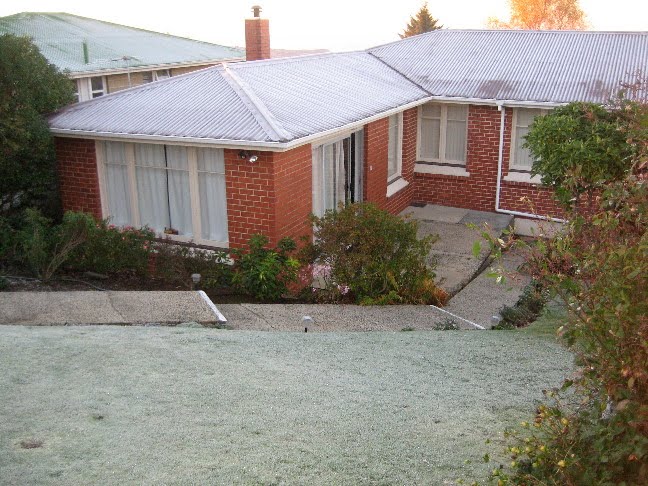
I did have thick frost a few weeks ago.

Saturday, June 12, 2010

Music in Dunedin

Since moving to Dunedin I have been able to attend many more live music performances than I was able to attend in Sydney. Although Sydney has the world renowned Opera House, Sydney Symphony and Australian Opera the performances tend to be very expensive and I had the problem of a 2 hour journey home, not very pleasant in the evening. My sister and I had a subscription and attended the afternoon symphony performances over the last few years but this was only 4 or 5 times each year.  There were a few local musical performances in the Blue Mountains or Penrith.

In the 4 months I have been in Dunedin I have attended one performance by the NZ Symphony and 3 performances by the Southern Sinfonia. They have all been excellent, costing about $25 or $30 and I have been home in less than 20 minutes after the finish.  I also attended a concert by Dame Malvina Major, and a performance of the musical Dusty and the Cologne Philharmonic performed Vivaldi's Four seasons.

Last Sunday evening I attended the Knox Presbyterian church which was celebrating its 150th Anniversary. Their choir combined with that of the Anglican cathedral and the Dunedin City choir to perform Mozart's Requiem.  David Burchell, the Cathedral and City organist performed Haydn's Organ Concerto in C as well as accompanying the choirs

The whole performance was excellent.

I was interested to read a history of the Knox church which is the 2nd Presbyterian church in Dunedin.  Dunedin was found by Scots and so the Presbyterian church is more numerous than the Anglican. The First Presbyterian church dominates the city but I believe is more conservative. The Knox church voted in the National assembly to allow same-sex partnered ministers but was not successful.

I have found a video of the Knox church on You-tube although the tourist cannot spell Dunedin.


I have also included one small section (not from last Sunday) of the Requiem for your enjoyment.


Tonight I am attending the Regent Theatre in the city which needs upgrading and there is a variety concert with all genre of music not just classical. Not sure it will be to my taste but I was invited by new friends and it is in a good cause.

Snow is forecast for tonight so I hope it does not start until after I get home.  If the roads are open tomorrow afternoon I may attend Faure's requiem to be performed by the City Choir in the Cathedral.

Dunedin is certainly living up to my expectation of providing me with a lot of music experiences.

Saturday, June 05, 2010

Bishops

I am happy to belong to an episcopal church but I am also happy that in the Anglican church we do not need to treat our bishops as little gods.

On Tuesday, while walking with the 60+ group I have recently joined, I was telling one lady how, before I moved to Dunedin, the only person I knew was the Vicar of Roslyn but shortly after my arrival he became the Bishop of Dunedin.  She asked me what I now called him with several suggestions (right rev, your worship).  I answered "I call him Kelvin".

I am glad to now live and worship in a diocese where I can respect the bishop and be in agreement with most of what he says.  I probably disagree with him on some matters and, if the opportunity arose and it was important enough, would tell him so.  From what I have seen so far they are more matters of degree rather than substance.  I respect his position as leader of the diocese and, in some mystical fashion, I honour that particular role conferred on him by ordination practised during church services particularly the Eucharist.  He will be returning to the parish of St John's Roslyn in a few weeks time for the Patronal festival and (I think) confirmation.

However in my previous life in the Diocese of Sydney I believed the bishops to be in grievous error.  They are preaching a gospel of hate completely different to what I have been able to discern as the teachings of Christ. Their gospel has no room for people like me who were created gay. Their views of women are not much better. Therefore they had lost all credibility with me and I had no respect for their position. If Archbishop Jensen had arrived at my parish church I would have immediately walked out.  I did attend one confirmation service where  Bishop Forsyth of South Sydney presided.  However it was difficult, his sermon and his actions confirmed my belief in his hypocrisy and I left by a side door. I did not attend the following year.

Sadly my view of the Archbishop of Canterbury is now not much better. He has been a great disappointment and while a learned man is also able to spout arrant nonsense.

I gained a great deal from my time working for the Catholic church but I always balked at the position given to the previous Pope. While he did some excellent things, I also believed him to be in error in many other ways and would never give him any special honour and my views on this matter were one of the reasons I was unable to convert to Roman Catholicism.  I had returned to the Anglican church by the time of the election of the present Pope. I do not have any respect for him at all.

On the other hand, and the reason for this post, I consider the Presiding Bishop of The Episcopal Church, the Most Rev. Katharine Jefferts Schori, to fill the post of bishop in an excellent manner.
Her recent pastoral letter is a great response to that of the Archbishop of Canterbury which I regarded as completely non-Anglican.
His attempt to usurp some central authority and decide who is in and who is out among the Provinces is just plain wrong. That sort of thinking is what I rejected in the Church of Rome.

The Anglican church has bishops, priests and deacons to provide good order and continuity. I do not believe they exist to rule. I accept the right to disagree with them and that any disagreement I might have with them should not give them the right to refuse my attendance at church and especially at the Eucharist. That decision is between me and God.

In the discussions of the recent Synod of the Province of Aotearoa, New Zealand there was general agreement that the first 3 sections of the proposed covenant presented no problem. However they have deferred any decision to ratify for 2 years because of problems with the 4th punitary section. From my reading I fear they either worry about being ignored as a very small part of the worldwide Anglican communion or consider that the whole issue will go away in the usual Anglican manner of avoiding anything that might be disagreeable. This latter seems to be the view of Bishop Kelvin. 

I worry that he does not fully comprehend the drive and determination of those like Jensen who would happily destroy the Anglican communion if they could gain their own way.
From what I have seen, even the evangelical Anglicans in New Zealand are essentially nice unless they are stirred up by those from across the Tasman.

If this covenant, including section 4, were to be accepted by provinces like New Zealand and as a result TEC and the Province of Canada were to be treated in some way as 2nd class because of their full inclusion of Gay people, I would no longer be able to regard myself as an Anglican.

I do not believe this will happen as I feel I have moved to a Province which is moving, perhaps a bit more tentatively, in the same direction as the Provinces of North America.